
by BBMiradas Autismo | 12 Nov 2021 | News
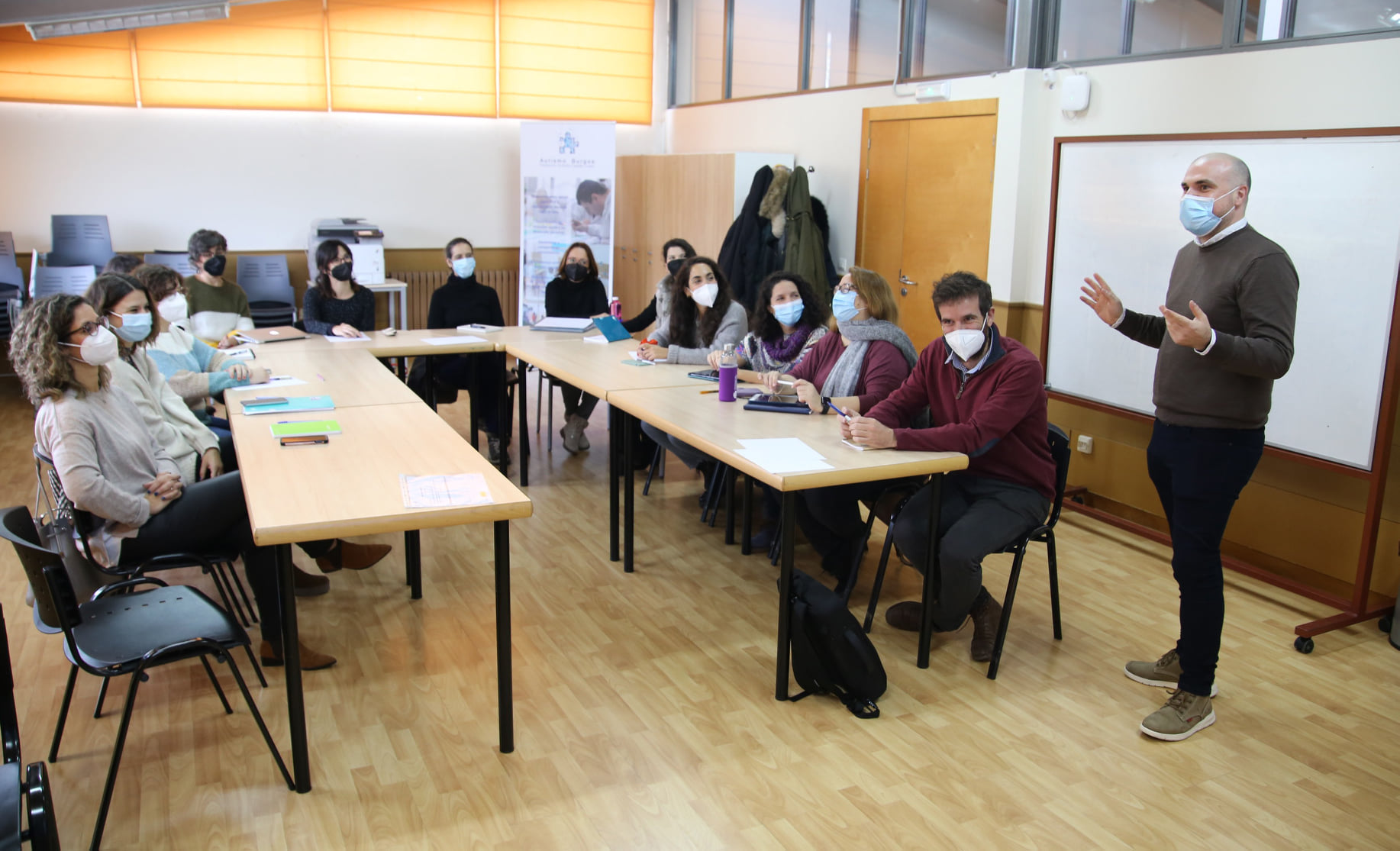
A total of five organisations – out of the eleven involved in the transfer process for the bbMiradas programme (all of which belong to the Autismo España network) – have travelled to Burgos to take part in the first face-to-face session of the transfer process for the programme aimed at the early detection and intervention for babies showing symptoms of Autism Spectrum Disorder (ASD).
The bbMiradas programme, launched by Autismo Burgos and the Miradas Foundation in 2017, has become a benchmark programme both nationally and internationally by using eye-tracking devices as a support tool in the diagnosis of autism in children under the age of 3. Having demonstrated its strength and reliability following years of study, learning and testing in the Castilian city, the programme is now, in collaboration with the Autismo España Confederation and with the support of the Ministry of Social Rights and the 2030 Agenda and the Carrefour Foundation, undergoing a phase of roll-out to eleven Spanish provinces through the involvement of a number of organisations belonging to the Autismo España network.
The event, the first and only in-person session of 2021, which will be followed by a series of online sessions in November and December, has been, in the words of Simona Palacios, president of the Miradas Foundation, “a meeting point for all the professionals and organisations involved in rolling out the programme. Today, Burgos has once again become a benchmark for the diagnosis of autism in babies”. The importance of the programme lies, as confirmed by Virginia Hortigüela, one of the foundation’s professionals, in the fact that if diagnosis is brought forward, intervention is brought forward; and with this, the course of development can be changed.
As for the prevalence of autism, in the absence of data for Spain as a whole, various figures are cited. One of these is the data published in 2020 by the US CDC (Centres for Disease Control and Prevention), which puts the prevalence at approximately 1 in 54 people. This high incidence means that today autism has been declared a public health issue in various countries, which has led to the development of various national strategies. In the case of Spain, the 2015 Spanish Strategy on Autism Spectrum Disorders.
According to the foundation’s staff, the bbMiradas programme has a threefold impact, as it affects not only the person with autism during their childhood and throughout their life, but also their family and society as a whole. Hence, early diagnosis is a vital tool for improving the quality of life of these individuals and their families, as well as for the wider systems, which will need to allocate fewer social, educational, health and economic resources, amongst others, to try to compensate for the difficulties associated with the diagnosis.
During the knowledge-sharing event, the importance of the partnership established with the public health system—and more specifically with Burgos University Hospital (HUBU) and the various teams of paediatric and neuropaediatric specialists—to the programme’s success was highlighted. In the view of the organising bodies, this has been key to the coordination and referral of patients, as well as to building trust among families at times of great uncertainty and fear, such as those experienced when the first warning signs appear. Since its launch in 2017, the bbMiradas programme has treated a total of 219 babies under 36 months, confirmed the diagnosis in 45 cases and provided support to a total of 64 children and their families; although these figures could have been higher had COVID-19 not forced the temporary suspension of consultations.
As Hortigüela confirms, these figures speak for themselves regarding the importance the programme is having in the province of Burgos for the families of these babies. As the programme is rolled out across the 11 provinces selected for this phase, between the end of this year and the start of next, the impact data will grow exponentially. Thus, the first to implement the programme in their regions will be the provinces of Seville, Murcia, Albacete, Badajoz and Granada, through the involvement of Autismo Sevilla, Astrade, Asociación Desarrollo and Apnaba, respectively.
In developing bbMiradas, the Burgos Autism Association and the Miradas Foundation have, over the years, benefited from the collaboration and support of various ministries of the Spanish Government, the Regional Government of Castile and León, Burgos City Council, the Spanish Autism Confederation, the Burgos University Healthcare Complex, the Burgos Foundation for Health Research, the University of Burgos, the Miradas Chair for Autism, the La Caixa Banking Foundation, the Caja Burgos Foundation, the Caja Círculo Foundation, the Ibercaja Foundation, the Gutiérrez Manrique Foundation, the ONCE Foundation, and the Burgos-based companies Hiperabaric, Desmasa and FAE.