
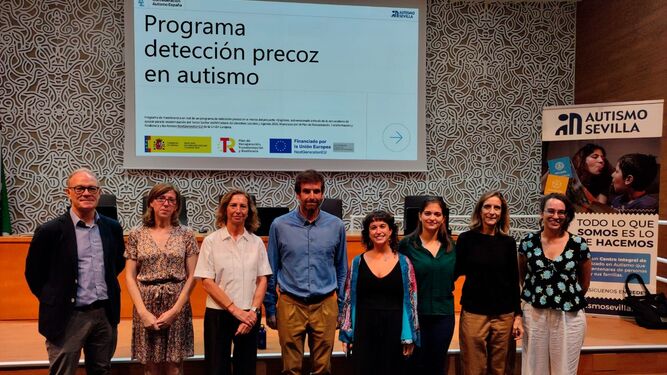
Autism Sevilla and Autism España present the early detection programme
To improve the identification of and access to early intervention for children with autism spectrum disorder (ASD) in Spain. These are the main objectives of the ASD early detection programme, which was presented in the Assembly Hall of the Faculty of Psychology in Seville, in collaboration with the Confederation Autism spain.
The Seville Autism Association is involved in the network-based dissemination of this important programme, which enables the identification of warning signs consistent with ASD from the age of 15 months, thereby bringing forward the age of diagnosis, which in Spain can be delayed by up to four years or even into adulthood.
Research shows that early detection and early intervention reduce the social, emotional and financial costs associated with ASD, both for families and for society as a whole, and that the age at which the condition is detected can be brought forward significantly if systematic child development monitoring processes are put in place (particularly for babies at increased risk of ASD due to family history or perinatal complications).
In Spain, these protocols are not included in the national healthcare system’s plans, and there is significant regional variation. This is why this process of transferring and implementing the early autism detection programme – which has so far been developed in the province of Burgos – across different autonomous communities is so important.
Eye-tracking technology for the early detection of ASD
The ASD early detection programme combines developmental monitoring through screening questionnaires, play observations and interviews with families, as well as research into early indicators using non-invasive eye-tracking technology. Since its launch in Burgos, it has identified 120 confirmed cases of ASD and provided specialised early intervention support to 135 babies. It has also trained more than 100 paediatricians, nursing staff, early intervention professionals and nursery school staff.
98% of the families who have taken part in the programme are very satisfied with the support they received and would recommend it as an essential service for families with similar needs.
Thanks to Autismo España, the current transfer process will see the methodological model for monitoring and assessing child development—developed by the Asociación Autismo Burgos and the Fundación Miradas—along with the protocols and tools used in clinical practice, rolled out to other parts of the country, such as Autismo Sevilla.
This activity forms part of the +Digitales project, which has received funding through the Ministry of Social Rights and the 2030 Agenda’s call for grants to modernise the third sector, financed by the Recovery, Transformation and Resilience Plan and the European Union’s NextGenerationEU funds.
The launch event was attended by David Saldaña, Dean of the Faculty and Director of the Autismo Sevilla Chair; María Verde, from Autismo España; Marcos Zamora, Managing Director of Autismo Sevilla; and Cristina López, the project coordinator for Autismo Sevilla. The event was brought to a close by Laura Caño Ramírez, Head of Early Childhood Intervention at the Regional Health Department.
In his speech, Marcos Zamora highlighted that the project is monitoring the development of babies under 12 months of age who have a family member diagnosed with an autism spectrum disorder. This monitoring takes place at the Faculty of Psychology’s own facilities and is led by professionals from the association. “With this x63 Programme, we want to make it easier for families to obtain an early diagnosis and, therefore, bring forward children’s access to early intervention as much as possible. This progress would mean reducing the support these children might need in the future,” he said.